





No comments yet
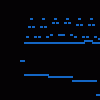
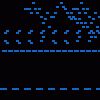
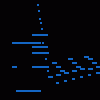
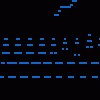
Chopin - Etude Op. 25 No. 1 "Aeolian Harp" in A♭ Major
Étude Op. 25, No. 1 in A-flat major is a solo piano work composed by Frédéric Chopin in 1836, and published in 1837. The work consists entirely of rapid arpeggios and harmonic modulations based on A-flat major.
Robert Schumann praised this work in a dissertation on the Études; calling it "a poem rather than a study", he coined for it the alternate name "Aeolian Harp". It is also sometimes known as "The Shepherd Boy," following an unsupported tale by Kleczyński that Chopin advised a pupil to picture a shepherd boy taking refuge in a grotto to avoid a storm playing the melody on his flute.
This étude comprises a right-hand melody and supportive bass line, the accompaniment consisting of broken chords, provided by the inner voices of both hands, usually in semiquaver-tuplets. The left hand introduces polyrhythms from time to time. The principal melody is presented by the right hand on the first note of each group of sextuplets, with occasional counter-melodies provided by the inner voices.
The distinctive theme is presented in A-flat major. Through metamorphic modulations to closely related keys, it eventually arrives at a brief episode in the remote key of A major, but culminates with an intense climax in the home key, and a momentary reference to the original thematic material, which flows easily into the coda.
Robert Schumann praised this work in a dissertation on the Études; calling it "a poem rather than a study", he coined for it the alternate name "Aeolian Harp". It is also sometimes known as "The Shepherd Boy," following an unsupported tale by Kleczyński that Chopin advised a pupil to picture a shepherd boy taking refuge in a grotto to avoid a storm playing the melody on his flute.
This étude comprises a right-hand melody and supportive bass line, the accompaniment consisting of broken chords, provided by the inner voices of both hands, usually in semiquaver-tuplets. The left hand introduces polyrhythms from time to time. The principal melody is presented by the right hand on the first note of each group of sextuplets, with occasional counter-melodies provided by the inner voices.
The distinctive theme is presented in A-flat major. Through metamorphic modulations to closely related keys, it eventually arrives at a brief episode in the remote key of A major, but culminates with an intense climax in the home key, and a momentary reference to the original thematic material, which flows easily into the coda.
0 Comments
No comments yet
Link to this sequence: 4367293
Simple
Advanced
Synthesizer
Instrument name
Mute
Solo
Copy
Load
Clone
Delete
Stack...
Clear Solo
Reset
Volume
Delay
Panning
Detune
Reverb
Distort
Equalizer
High
Mid
Low
Bitcrusher
Synthesizer
Resonance (Q)
LFO
1/4
Envelope
A
D
S
R
Offset
Delay
BPM
Title
Instrument
- Select/deselect notes
- Select/deselect markers
- Save a copy
- Save offline
- Export MP3
- Export WAV
- Export MIDI
- Import MIDI/Sequence File
- Fast graphics
- Invert
- Minor ⇄ Major
- Reverse Selection
- Humanize Selection
- Legatomize Selection
- Fade In Selection
- Fade Out Selection
- Stretch Selection
0
Connect a MIDI keyboard.
Record keyboard and MIDI inputs.
Snap recorded notes to the grid.
Filter recorded notes using the key guide.
Play a metronome. When recording, gives a 4 beat lead in.
OnlineSequencer.net is an online music sequencer. Make tunes in your browser and share them with friends!
Made by Jacob Morgan and George Burdell
·
Hosting 5,195,327 sequences since 2013 ·
Buy us a ☕ ·
Privacy
·