









#
TITLE
1 reply
1 reply
1 reply
1 reply
1 reply
2 replies
"what key is this in?" "yes."
Screw the rules of music theory, I CAN DO WHATEVER I WANT- (i wrote this mostly on the last day of school btw)
05/29/2025
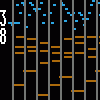
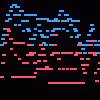
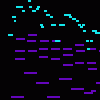
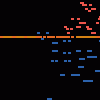
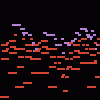
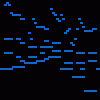
Étude in C Major, Op. 3, No. 2. Nicknamed "Polytonale" for obvious reasons.
Atonality is a fairly new concept, only really being used in the last 100 years (unless you count the 4th movement of Funeral March) by people like Stravinsky and Schoenberg (which I haven't really wanted to listen to because: 1. my perfectionist brain would try to find a key and 2. they're not Romantic Era composers.) However, I haven't seen any pieces where the 2 staffs have different key signatures. If you have seen the description for Rush B-flat, you know exactly where this is going. I made it mys-
Even though it's technically in C Major, this feels nothing like C Major. I stayed pretty safe with this, using keys with the same amount of sharps and flats. That's why I made it start in C Major. That means bars 42-45 aren't in the same key.
Polytonality (much like atonality) is a very delicate thing. If you think you know what you're doing, you probably don't. Stravinsky definitely thought he knew what he was doing.
Breaking down the sections because yes (formatted bottom staff/top staff):
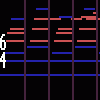
1-9: C Major, Vivace
10-17: F Major/G Major, Allegretto cantabile
18-25: B-flat Major/B Minor, Andante
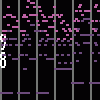
26-29: C Minor/F-sharp Minor, Veloce agitato (this was the hardest to compose because tritones)
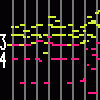
30-33: A-flat Major/E Major (same tempo as the previous section)
34-41: D-flat Major/B Major, Tempo I
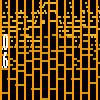
42-45: G-flat Major/F-sharp Major, Moderato (essentially the same key, but still wanted to keep the effect)
46-53: The key signatures flip, and then each staff loses an accidental every bar
54-end: C Major, Tempo I (64-71 is coda)
05/29/2025
Étude in C Major, Op. 3, No. 2. Nicknamed "Polytonale" for obvious reasons.
Atonality is a fairly new concept, only really being used in the last 100 years (unless you count the 4th movement of Funeral March) by people like Stravinsky and Schoenberg (which I haven't really wanted to listen to because: 1. my perfectionist brain would try to find a key and 2. they're not Romantic Era composers.) However, I haven't seen any pieces where the 2 staffs have different key signatures. If you have seen the description for Rush B-flat, you know exactly where this is going. I made it mys-
Even though it's technically in C Major, this feels nothing like C Major. I stayed pretty safe with this, using keys with the same amount of sharps and flats. That's why I made it start in C Major. That means bars 42-45 aren't in the same key.
Polytonality (much like atonality) is a very delicate thing. If you think you know what you're doing, you probably don't. Stravinsky definitely thought he knew what he was doing.
Breaking down the sections because yes (formatted bottom staff/top staff):
1-9: C Major, Vivace
10-17: F Major/G Major, Allegretto cantabile
18-25: B-flat Major/B Minor, Andante
26-29: C Minor/F-sharp Minor, Veloce agitato (this was the hardest to compose because tritones)
30-33: A-flat Major/E Major (same tempo as the previous section)
34-41: D-flat Major/B Major, Tempo I
42-45: G-flat Major/F-sharp Major, Moderato (essentially the same key, but still wanted to keep the effect)
46-53: The key signatures flip, and then each staff loses an accidental every bar
54-end: C Major, Tempo I (64-71 is coda)
16 Comments
WHOA- This is really impressive, where did you lean to do this??
"I turn 13 in a month" oh yes
and here i thought me being 15 on this site was young. lmao
"I turn 13 in a month" and it's a heavenly work of art
1 reply
I am now :)
ME TOO!!
1 reply
9 days now haha. Time is weird
"I turn 13 in a month-)" 🔥🔥🔥
1 reply
why do i like to act as if no elementary/middle-schooler should write with adult grammar
that passage from 54-63 is gorgeous wow
1 reply
Thanks, I tried not to make the whole thing sound like a 20th-century experiment (*cough*ligeti*cough*).
funky cool :3
1 reply
Thanks, do you know anything about classical music?
very nice
Link to this sequence: 4715725
Simple
Advanced
Synthesizer
Instrument name
Mute
Solo
Copy
Load
Clone
Delete
Stack...
Clear Solo
Reset
Volume
Delay
Panning
Detune
Reverb
Distort
Equalizer
High
Mid
Low
Bitcrusher
Synthesizer
Resonance (Q)
LFO
1/4
Envelope
A
D
S
R
Offset
Delay
BPM
Title
Instrument
- Select/deselect notes
- Select/deselect markers
- Save a copy
- Save offline
- Export MP3
- Export WAV
- Export MIDI
- Import MIDI/Sequence File
- Fast graphics
- Invert
- Minor ⇄ Major
- Reverse Selection
- Humanize Selection
- Legatomize Selection
- Fade In Selection
- Fade Out Selection
- Stretch Selection
16
Connect a MIDI keyboard.
Record keyboard and MIDI inputs.
Snap recorded notes to the grid.
Filter recorded notes using the key guide.
Play a metronome. When recording, gives a 4 beat lead in.
OnlineSequencer.net is an online music sequencer. Make tunes in your browser and share them with friends!
Made by Jacob Morgan and George Burdell
·
Hosting 5,196,364 sequences since 2013 ·
Buy us a ☕ ·
Privacy
·